Newburyport and the Civil War by William Hallett
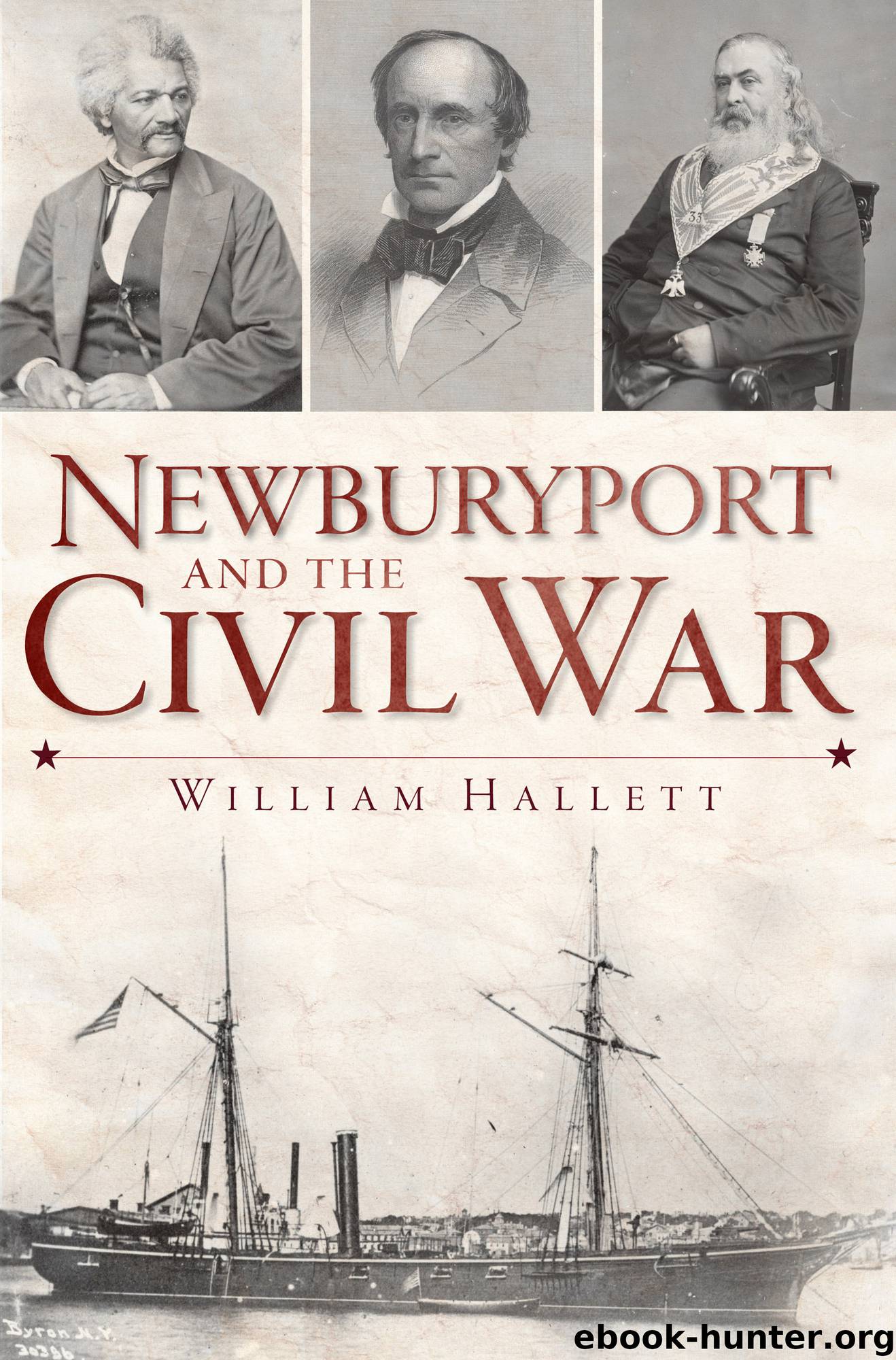
Author:William Hallett
Language: eng
Format: epub
Published: 2019-02-13T16:00:00+00:00
North Church on Brown Square was not pleased with William Lloyd Garrison and told him not to return. Years later, a statue of Garrison was placed within yards of the front door. WHC .
Boston was not completely behind the abolitionists either—one time, when Garrison went to speak at the Female Anti-Slavery Society meeting, a mob grabbed him. His clothes were ripped and his hat taken. A noose awaited Garrison, and he was only saved at the last minute. Although never proven, it was often circulated among groups that Boston mayor Theodore Lyman may have been behind the frightful night. He was a member of a proslavery group meeting at Faneuil Hall and had guests from the South that night.
During this period in Boston history, Irish immigrants were coming in waves and settling into their new lives. Irish were typically considered the lowest in society and, fearful of jobs that any freed men of color might take, were very much against the abolitionist groups. Garrison found it difficult to find any venues at which he could speak or hold rallies.
On January 31, 1865, with slavery all but history, the members of the New England Anti-Slavery Society deemed no reason to continue and disbanded. At the end of March that year, William Lloyd Garrison was in Newburyport addressing a crowd at city hall. He referred to his time there and to the antislavery movement. He couldn’t help but mention his conflict with Francis Todd. He reminded the citizenry how he had been refused the chance to lecture; just five years before, he would have been “kicked out of the city.” He gave thanks to his friend John Greenleaf Whittier and read a hymn by the poet. He stated that he had come this time at the request of the people of Newburyport, and he made a prophetic statement when he claimed that one day Newburyport would be proud of him.
The day that the Stars and Stripes was hoisted over Fort Sumter, just days after Lee’s surrender to Grant, Garrison was on hand to witness the flag ripple in the Charleston Harbor breeze. He was there with Governor Andrew and other dignitaries.
The year 1865 saw the last issue of the Liberator, published in December, just months after William Lloyd Garrison resigned from the American Anti-Slavery Society. He turned his attention to other causes, such as the prohibition of alcohol, which was now gaining in popularity. But he never quit writing against the things he felt strongly about when it came to how the South was now being treated. He protested Robert E. Lee’s position at Washington College, and when President Hayes formally announced that he would withdraw troops from the Southern states, ending the occupation and consequentially ending Reconstruction as well, Garrison attacked that decision with the same intensity he had in his younger days.
Garrison died in New York on May 24, 1879. His remains were returned to Massachusetts, where he was interred at Forest Hills Cemetery in Roxbury.
History has a sense of
Download
This site does not store any files on its server. We only index and link to content provided by other sites. Please contact the content providers to delete copyright contents if any and email us, we'll remove relevant links or contents immediately.
| Africa | Americas |
| Arctic & Antarctica | Asia |
| Australia & Oceania | Europe |
| Middle East | Russia |
| United States | World |
| Ancient Civilizations | Military |
| Historical Study & Educational Resources |
Cat's cradle by Kurt Vonnegut(15468)
Pimp by Iceberg Slim(14713)
4 3 2 1: A Novel by Paul Auster(12544)
Underground: A Human History of the Worlds Beneath Our Feet by Will Hunt(12172)
The Radium Girls by Kate Moore(12119)
Wiseguy by Nicholas Pileggi(5874)
The Fire Next Time by James Baldwin(5538)
Perfect Rhythm by Jae(5497)
American History Stories, Volume III (Yesterday's Classics) by Pratt Mara L(5348)
Paper Towns by Green John(5265)
Pale Blue Dot by Carl Sagan(5098)
A Higher Loyalty: Truth, Lies, and Leadership by James Comey(5031)
The Doomsday Machine by Daniel Ellsberg(4577)
The Mayflower and the Pilgrims' New World by Nathaniel Philbrick(4569)
Killers of the Flower Moon: The Osage Murders and the Birth of the FBI by David Grann(4498)
The Sympathizer by Viet Thanh Nguyen(4463)
Too Much and Not the Mood by Durga Chew-Bose(4407)
The Borden Murders by Sarah Miller(4402)
Sticky Fingers by Joe Hagan(4268)
